Health Screenings
Here at VIP we want to breed and raise puppies that will live long fulfilling lives, and we take health testing very seriously. Working for over 14 years in an animal shelter we’ve seen first-hand the heart break that comes along with not health testing your breeding stock.
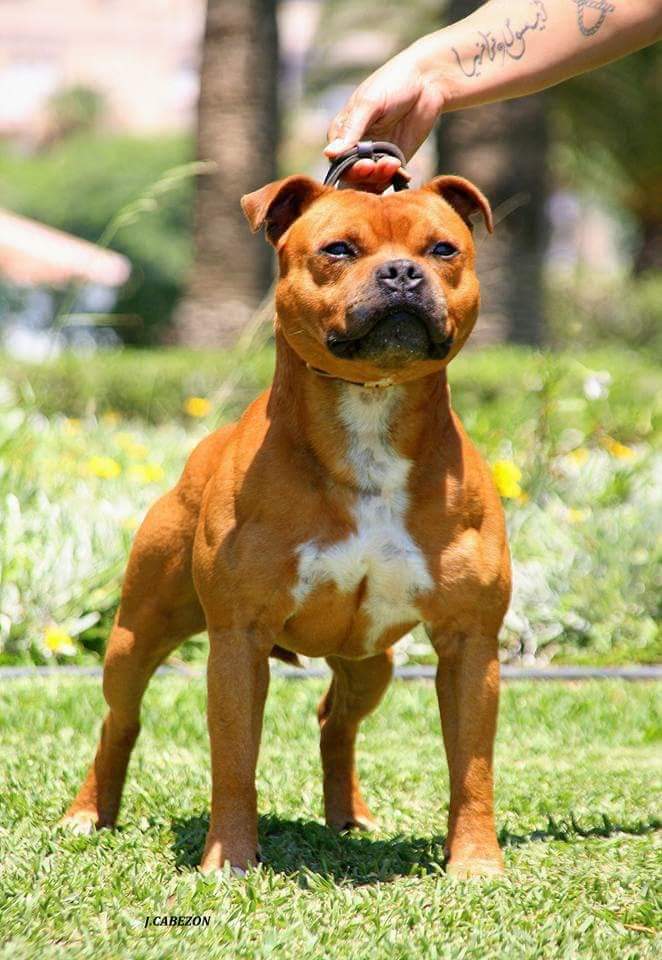
The risks for many significant health issues can be greatly reduced through careful breeding practices, beginning with certain screening and examinations of each parent of a litter. Each breed has its own particular hereditary problems; The Staffordshire Bull Terriers are no exception to this! Outlined below are the steps we take to assure we are breeding for this goal.
Screen for L2-Hga Gene | Screen for Hereditary Cataracts | Preform Eye Exams
Hip Evaluation |Elbow Evaluation | Cardia Evaluation
|Patella Evaluation

The Orthopedic Foundation for Animals (OFA) was founded as a private, not-for-profit foundation in 1966 by John M. Olin, a well-known inventor, industrialist, philanthropist, conservationist, and sportsman.
Olin was an avid sportsman, hunter, and field trial participant. When hip dysplasia began to impact the performance of Olin’s dogs, he organized an initial meeting with representatives of the veterinary community, the Golden Retriever Club of America, and the German Shepherd Dog Club of America to discuss means of limiting the disease. This ultimately led to the formation and incorporation of the OFA. Its initial mission: To provide radiographic evaluation, data management, and genetic counseling for canine hip dysplasia.
While the OFA continues to focus on hip dysplasia, today’s mission, “To improve the health and well-being of companion animals through a reduction in the incidence of genetic disease,” reflects the organization’s expansion into other inherited diseases and other companion animals such as cats.
The OFA created the Canine Health Information Center (CHIC) by partnering with participating parent clubs to research and maintain information on the health issues prevalent in specific breeds. We’ve established a recommended protocol for breed-specific health screenings. Dogs tested in accordance with that protocol are recognized with a CHIC number and certification.
At OFA, we recognize that the more information stored and accessible in these databases, the better it will be for every breed. And so, we encourage all breeders to attain CHIC Certification if their breed participates in the CHIC program.
A dog achieves CHIC Certification if it has been screened for every disease recommended by the parent club for that breed and those results are publicly available in the database.
Clear by Parentage’. If CBP, you should be able to view the parents/grandparents DNA records to prove that they were clear of this disease, so therefore unable to pass it on to their offspring.
tested or ‘Clear by Parentage’. If CBP, you should be able to view the parents/grandparents DNA records to prove that they were clear of this disease, so therefore unable to pass it on to their offspring.
showing they have been checked and cleared for PHPV and other hereditary or congenital eye anomalies.
OFA hip certification is a permanent record of a dog’s hip status used to screen for hip dysplasia and guide breeding decisions. It involves a veterinary radiographic evaluation of the hips, typically performed on dogs aged 2 years or older. Certification can indicate hips are normal or have findings within acceptable limits, helping breeders avoid passing on hip dysplasia
OFA Elbow Certification assesses whether a dog has elbow dysplasia by radiographic evaluation, with the elbow joints scored to determine normal vs. dysplastic findings for OFA registration. The dog must be at least 2 yrs of age to have elbows certified as normal. This certification helps breeders reduce the incidence of genetic elbow problems by documenting if an elbow is normal or dysplastic
Congenital heart disease in dogs is a malformation of the heart or great vessels. The lesions characterizing congenital heart defects are present at birth and may develop more fully during perinatal and growth periods. Many congenital heart defects are thought to be genetically transmitted from parents to offspring; however, the exact modes of inheritance have not been precisely determined for all cardiovascular malformations.
OFA Patella Certification is a veterinary screening that checks a dog’s kneecaps for patellar luxation and records the result in the OFA database. It begins with a physical exam performed by a licensed veterinarian, and the dog is then given a classification (typical results are normal or within acceptable limits). The certification helps breeders and owners track knee-health and informs breeding decisions to reduce knee problems in future generations.